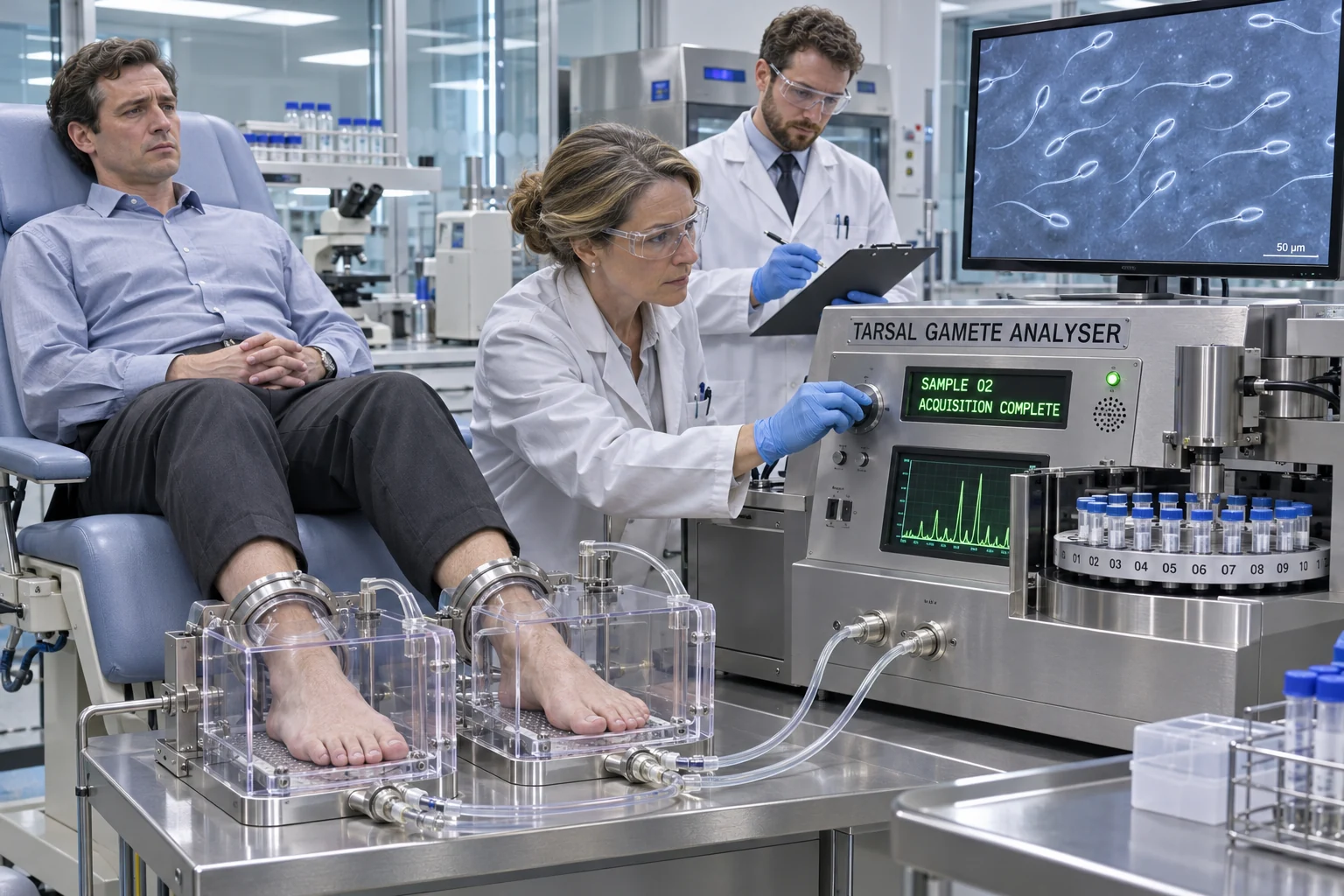
For many years, men reporting reproductive activity below the knee were referred to podiatry.
Podiatry referred them back.
This exchange, now recognised as the principal mechanism of diagnostic delay, did little to advance our understanding of tarsal spermatogenesis. Patients accumulated insoles. Relationships suffered. In one well-documented case, a man in Warwickshire was advised to walk it off.
He did, briefly becoming the largest contributor to a regional footpath survey.
Today, improved sampling techniques allow us to distinguish between three conditions previously grouped under the unhelpful term “spunk feet”: passive seminal transudation, active plantar production, and contamination during the putting-on process.
The distinction matters.
Only one of these requires a different sock.
Production or mere passage?
The central question is whether the foot manufactures spermatozoa or simply provides an alternative exit.
Early investigators favoured the latter explanation, proposing that reproductive material descended under gravity through the leg. This model enjoyed considerable support until the publication of the Upside-Down Birmingham Cohort, whose participants continued to produce despite being inverted.
The resulting paper, Against the Fall, established two important points: gravity was insufficient to explain the phenomenon, and the university’s gymnastics department should have been consulted earlier.
The current model locates production within the accessory tarsal seminiferous complex, a fine network of reproductive tubules surrounding, but not formally employed by, the ankle.
Its activity is regulated by the plantar–gonadal axis, with local expression mediated through follicle-stimulating gait.
In practical terms, the foot has begun interpreting certain forms of walking as an instruction.
The collection problem
A productive foot does not necessarily produce a useful sample.
Standard cotton absorbs fluid readily but retains cells unevenly. Wool introduces directional bias. Polyester preserves motility while creating conditions the researchers described as “socially difficult”.
These differences prompted the development of the Sock Recovery Equation:
R = (N × μ × τ) / (1 + κ)
Here, R is recoverable yield; N, the number of locally produced spermatozoa; μ, fibre-mediated retention; τ, effective wearing time; and κ, the degree to which the patient’s wife has already put it through a mixed wash.
For laboratory purposes, wearing time is expressed in standard sock-hours. One foot wearing one sock for one hour constitutes one sock-hour. A pair worn for an afternoon constitutes a sample and, usually, a conversation.
Values of κ above 0.8 render most findings inconclusive.
Fabric conditioner does not improve confidence.
Why the ankle?
The location has attracted considerable speculation.
The Economy of Descent Hypothesis proposes that the body has moved production closer to where men habitually leave things. The competing Peripheral Succession Model suggests the foot is preparing to assume broader responsibilities in later life.
Neither model adequately explains why activity frequently begins in the less competent foot.
Bilateral studies have, however, established a consistent asymmetry: one foot tends towards production, while the other develops a supervisory role.
Patients often identify the distinction before clinicians do.
“It’s the left that does it,” one participant reported. “The right just seems to know.”
A note on measurement
Published estimates of prevalence vary widely, largely because early surveys asked men whether their feet were “reproductively active” without specifying a reference period.
Several respondents included dancing.
The landmark Mercer trial attempted to resolve this through direct comparison of forty men wearing identical laboratory socks. Unfortunately, the control group wore sandals, compromising both blinding and three subsequent meta-analyses.
More recent work uses a within-shoe crossover design, in which each participant serves as his own control until the shoes become distinguishable.
Results are encouraging, although the right shoe has submitted a separate account.
Crucially, plantar viability must not be confused with intent. A cell moving decisively towards the toe has not necessarily formed a plan.
The patient experience
Technical progress has outpaced the language available to families.
One patient described the difficulty of explaining why he had begun labelling his laundry.
Another found that his wife’s apparently supportive suggestion that he “put his feet up” carried an unbearable weight of expectation.
For many, the greatest concern is accidental contribution.
Current evidence suggests that ordinary walking presents a low risk, particularly on sealed surfaces. Carpet studies remain difficult to interpret because participants cannot reliably identify which areas they have already apologised to.
Public swimming pools present a separate challenge.
We await permission to discuss it.
Looking ahead
The next generation of collection hosiery promises improved recovery without compromising ordinary use.
Prototype provenance socks maintain separate left- and right-foot records, while a small tab at the heel indicates whether a sample has matured sufficiently to be introduced to anyone.
These advances should make monitoring less intrusive.
They do not resolve the more personal question of what a man is expected to do with the information.
One participant, a retired surveyor, had recorded stable production for eighteen months. His laboratory results were excellent. His marriage remained strong. He had found a sock he could trust.
Asked whether he felt reassured, he considered the question for some time.
“I suppose,” he said.
Then he looked towards the window.
“I used to enjoy walking.”