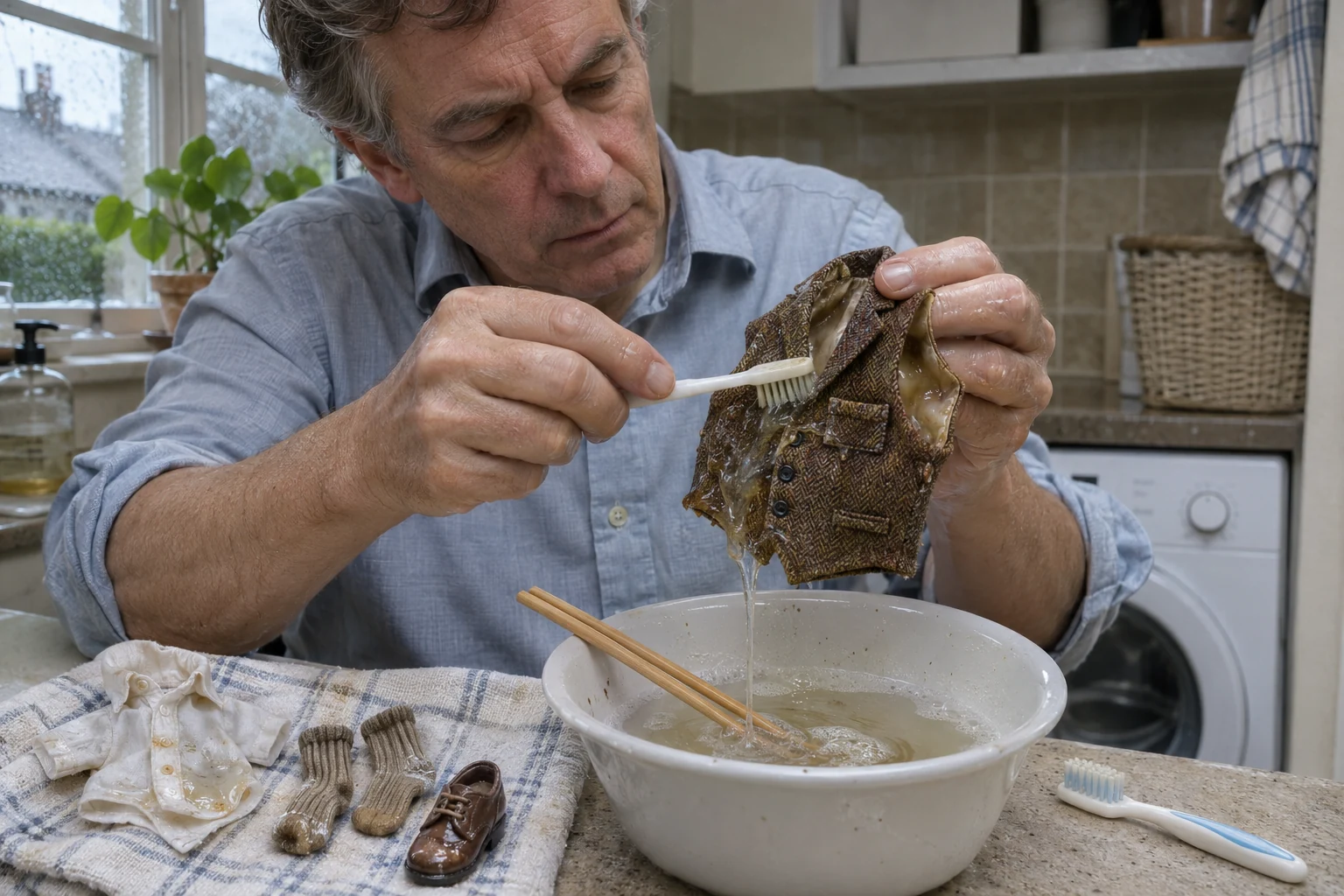
The first sock was small enough to dismiss.
A dark, ribbed article, no longer than the last joint of my thumb. It lay against the bowl just above the waterline, where I initially took it for something less specific.
I put on my glasses.
There was a heel.
I waited until my wife had finished her breakfast.
“Have we lost anything?”
She looked around the kitchen.
“From where?”
I found I had not prepared an adequate answer.
For several days, I favoured accidental ingestion.
I had eaten hurriedly at a conference. There had been a buffet, cloth napkins and a poorly lit selection of things on sticks.
A small sock could conceivably have entered proceedings.
Then, on Thursday, its partner arrived.
It was slightly darker.
This suggested either separate production or a difference in washing history, neither of which helped.
I retrieved it using the little plastic spoon from an old tub of wood filler. After rinsing, I left it on kitchen paper beside the first.
My wife came in while I was examining the toes.
“Why are those wet?”
I explained.
She put down her shopping.
“Was that our sieve?”
The GP asked about changes in diet, medication and bowel habit.
I told him the habit was broadly unchanged, apart from the clothes.
He took this professionally.
“Just the socks?”
“So far.”
“Any sign of a waistband?”
I said there wasn’t.
He seemed reassured, although I would have preferred to understand the question before benefiting from the answer.
I showed him a photograph.
He enlarged it, then enlarged it again.
“May I?”
I passed him the phone.
He turned it sideways.
“That’s a proper gusset.”
The waistcoat appeared eleven days later.
By then, I had become reasonably efficient at recovery. I had a dedicated bowl, a pair of wooden chopsticks and an understanding with my wife about the utility sink.
Nevertheless, the waistcoat required patience.
It was folded into a deep fissure along the upper surface of an otherwise unremarkable movement. At first, only one button was visible.
I eased it free.
A thin strand of mucus stretched from the lining before releasing with a small, reluctant sound.
I remember feeling pleased that I had not torn the pocket.
This was the first occasion on which I became concerned about how quickly my standards were changing.
The consultant examined it under a light.
He was interested in the stitching.
“Attached fibres generally suggest something swallowed,” he explained. “These appear to have been incorporated during formation.”
He lifted a corner with tweezers.
A little brown material remained beneath the seam.
He asked his assistant for a smaller pair.
I looked at the ceiling.
Eventually, he placed the waistcoat on a clean pad.
“Locally produced,” he said.
“By me?”
“Within you.”
He allowed the distinction to settle.
The fabric was not, strictly speaking, wool. Laboratory analysis had identified a dense proteinaceous fibre with what the report called a convincing handle.
The buttons were formed from compacted mineral salts.
One had a slight imperfection near the rim.
I had noticed that myself.
Dressing for departure
There were two possible interpretations.
The first was that my bowel had begun producing garments incidentally, in the way an oyster might produce a pearl.
The second was that something had begun dressing for departure.
“Something?”
The consultant folded his hands.
“At present, we have evidence of clothing.”
I asked whether that was the same as saying there was no evidence of a wearer.
He agreed that it was.
For a moment, I felt better.
Then he asked whether any of the garments had been warm.
My wife bought a small lidded container.
She labelled it HIS.
I thought this premature.
“I mean you,” she said.
At her suggestion, I began keeping a record. Date, consistency, recovery conditions, garment.
The practical difficulties were considerable.
A cuff might be visible only after the surrounding material had softened. Trouser legs had a tendency to retain matter at the knee. Anything pleated needed time.
I learned to work beneath the surface of the water.
On one memorable morning, I teased what I thought was a collar from the tapered end of a stool and discovered I had been pulling on the back of a necktie.
It came out slowly.
I had to stand up.
Afterwards, I sat on the edge of the bath for a while, holding the clean end.
My wife knocked.
“Are you all right?”
“Yes.”
“Only the plumber’s here.”
I asked her to give me ten minutes.
There were no trousers for several weeks.
I found this oddly exposing.
The waistcoats continued. A shirt. Another shirt, better finished. Then, during a difficult period at work, a single brown shoe.
The sole was convincing.
Inside, however, the toe contained a soft deposit I could not remove without damaging the structure.
I took it to the clinic.
The consultant said it was not uncommon for early footwear to be incompletely cleared.
He recommended a soft brush.
I asked whether he meant a toothbrush.
“Preferably one you haven’t allocated elsewhere.”
By December, the arrangement had become domestic.
Recovery took place before my shower. Items requiring attention were left to soak. My wife had cleared a shallow drawer in the spare room, although she asked that I stop referring to it as a wardrobe.
We had rules.
Nothing on the draining board.
Nothing in with the normal wash.
And if her sister came to stay, everything had to be put away properly.
One evening, my wife found me drying a jacket on a clean tea towel.
“Is that new?”
I said it was.
She felt the sleeve.
“Better than the last one.”
I nodded.
The previous jacket had developed a sourness around the shoulder that no amount of rinsing could entirely resolve.
This one was sound.
She smoothed the lapel.
“Don’t wring it.”
“I know.”
“I’m only saying.”
We stood together for a moment, looking at it.
Then she went to turn the potatoes.
I cannot tell you precisely when disgust became administration.
There was certainly no decision.
But one Saturday, as I held a movement steady with the chopsticks and gently worked a little sleeve from its underside, my chief concern was whether I would finish before the post office closed.
The sleeve released.
I rinsed it.
There was a working button at the cuff.
I felt the modest satisfaction of a job completed carefully.
The consultant says progress remains difficult to define.
Nothing has indicated occupancy. The garments vary in size, although they appear to share a general preference for natural colours.
Last month, he asked whether I still found the process distressing.
I said that some days were easier than others.
He waited.
“I’d like a second shoe.”
He made a note.
On Monday, nothing arrived.
The movement itself was entirely ordinary. I examined it with the care I now brought to these occasions, then checked once more before flushing.
On Tuesday, the same.
I told my wife over dinner.
“Perhaps it’s settled down.”
I agreed that this was possible.
She watched me for a moment.
“You seem disappointed.”
I said I was merely reporting a change.
On Wednesday, I woke early.
There was no urgency. No discomfort. The bathroom was cold, and I had to wait for the light above the mirror to stop flickering.
Afterwards, I looked.
At first, nothing seemed different.
Then, resting neatly in the shallow depression at the top, I saw a pale blue edge.
I recovered it slowly.
The material unfolded beneath the water. Soft cotton. A little piping. Two buttons, both intact.
Pyjamas.
I rinsed them, pressed out the water between my palms and laid them flat.
The trousers had been folded inside the jacket.
For some reason, that undid me.
My wife found me sitting beside the bath.
She looked at the towel.
Neither of us spoke for a while.
Then she put her hand on my shoulder.
“Leave them,” she said. “I’ll do those.”